The Beer Game:
play the supply chain simulation online

Discover the supply chain simulation developed at MIT, where four teams manage a beer supply chain and watch small demand changes spiral into the bullwhip effect.

Play the demo

Free - no signup required

Sign up as Instructor

Manage sessions, invite players

Customer Ratings - Zensimu Beer Game

Rated 4.9/5 by our customers since 2021.

Airbus
New York University
Kellogg's
SDA Bocconi School of Management
Bose
Airbus
New York University
Kellogg's
SDA Bocconi School of Management
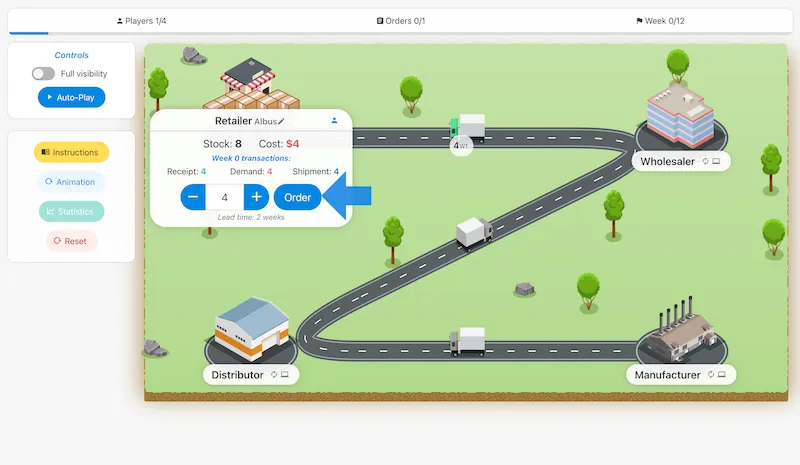
Beer Game demo preview

The Object of the Beer Game

The aim of the game is to fulfill requests at each stage of the supply chain in order to meet the overall demand of end customers.

Players are assigned to a role in their specific industry. For example, in a beer supply chain simulation, participants play as either Manufacturer, Distributor, Wholesaler, or Retailer.

Each role responds to order requests from the stage below and places orders for the stage above.

→ The resulting game experience provides insights into:
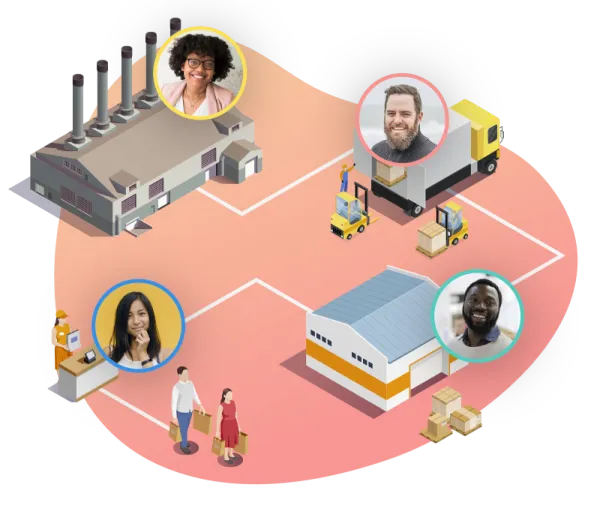
Big illustration of the Beer Game
Basic supply chain concepts icon

Basic supply chain concepts

Stock, lead time, costs, orders, demand, etc.

The Bullwhip Effect icon

The Bullwhip Effect

How small changes in demand can create large swings in orders and inventory.

Effects of human behavior icon

Effects of human behavior

How collaboration - or lack of - can impact overall performance.

Impact of various supply parameters icon

Impact of various supply parameters

Visibility, batches, price fluctuations, etc.

Read what our customers say

How to play

How to play the Beer Game

Four roles make up the chain: Retailer, Wholesaler, Distributor and Manufacturer. Each one has a client to ship to and a supplier to order from. Demand travels up the chain; beer travels back down.
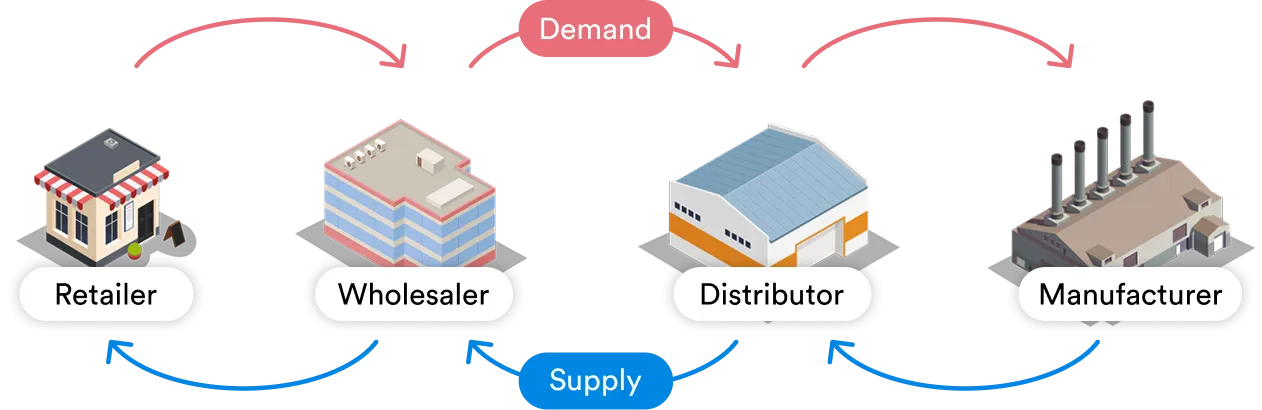
The Beer Game supply chain: demand flows up from the Retailer, supply flows back down from the Manufacturer

Every week, each player does two things:

1

Receive and ship

Cases arrive from your supplier. Your client’s order comes in, and you ship what you can from stock. Anything you can’t ship becomes a backorder (your client is still waiting for it).

2

Order

Decide how many cases to order from your supplier, based on your stock, the demand you’ve seen so far, and the deliveries already on their way.

The catch is the delay. An order placed in week 0 doesn’t arrive until week 3 (in the standard settings), so you’re always ordering for demand you can’t see yet.

Both mistakes cost money: holding stock costs $0.50 per case per week, backorders cost $1.00. The aim is to finish with the lowest cumulative cost.

Two rules make this harder than it sounds. You can’t see what your client will order next, and you can’t talk to the other players. All you have is your own history and your judgement. The game runs for an unknown number of weeks, and any empty seat is played by the computer.

Use cases

Adopted across various contexts and occasions

Corporate and Team Events use case icon

Corporate and Team Events

In-company training session, team-building workshop, project kickoff meeting, onboarding program, strategic planning sessions

Conferences and Public Engagements use case icon

Conferences and Public Engagements

Seminars, kickoff meetings, industry networking events, trade shows, and exhibitions

University and Educational Development use case icon

University and Educational Development

University training programs, bootcamps, contests across universities, introductory courses

Consulting and Client Engagement use case icon

Consulting and Client Engagement

Sales demo, Kickoff client's presentation, Client-focused workshops, Coaching sessions

Running a session at work or university?

Discover the game in a live 1:1 demo

Learn more and get all your questions answered with one of our gamification expert.

What players discover

The Bullwhip Effect

Play the game and something strange happens: end-consumer demand barely moves, yet by the time the signal reaches the Manufacturer, orders are swinging wildly. That’s the bullwhip effect — a small flick at the handle becomes a large crack at the tip.
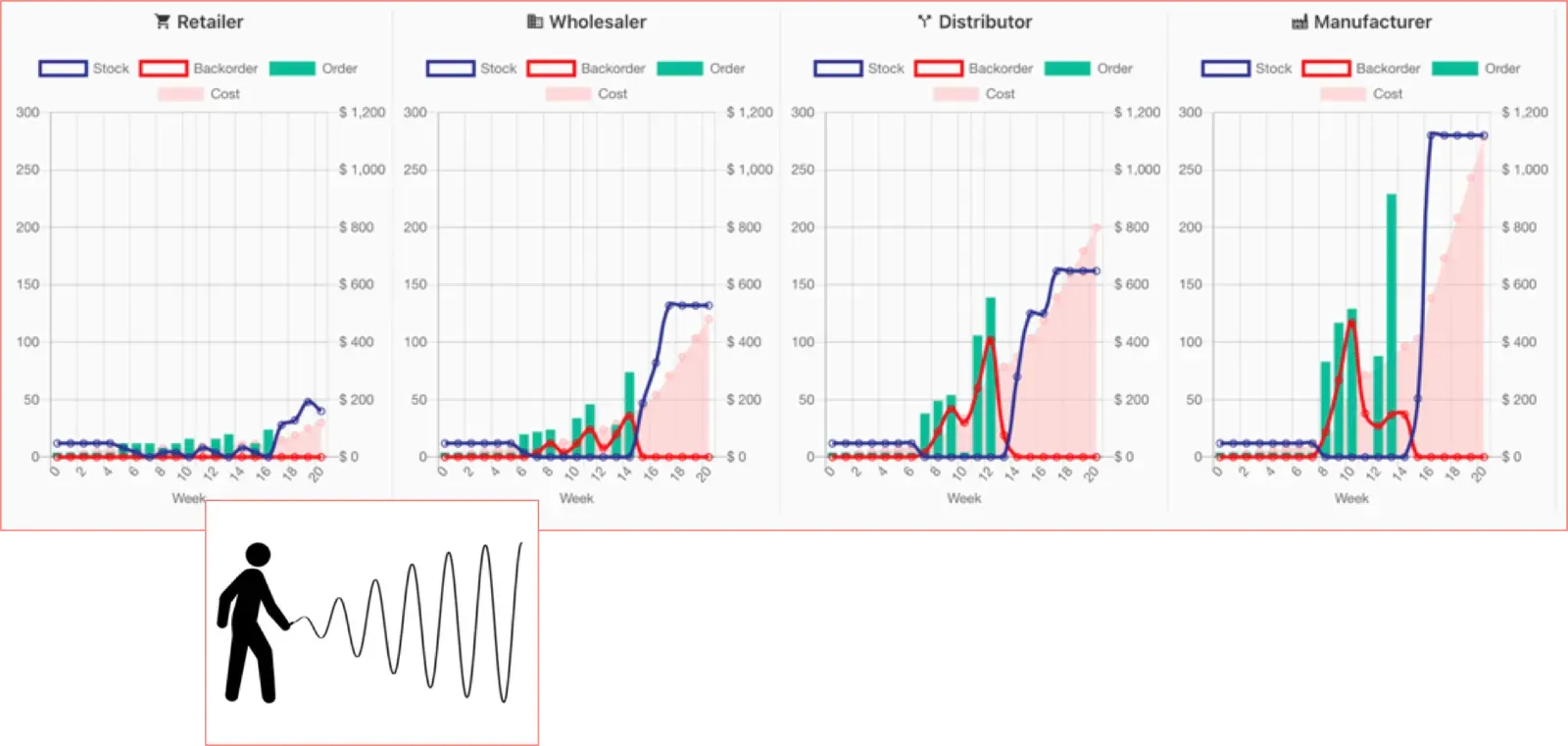
Beer Game charts showing order variation amplifying from the Retailer to the Manufacturer

It isn’t caused by the customer; it’s caused by the structure. Each player sees only their own client’s orders and waits weeks for deliveries, so when stock runs low, ordering extra feels sensible. The player above reads that inflated order as real demand and does the same — until a two-case change at the shop is a thirty-case swing at the factory.

Nobody plays irrationally — every decision is locally sensible. The oscillation appears anyway, and that’s what makes the lesson stick.

Read our full guide to the bullwhip effect →

Beer Game Bubbles background

This isn’t a drinking game,
so why is it called the Beer Game?

The name comes from a role-playing game developed at MIT in the 1960s: professors found they could grab students’ attention far more effectively by calling it the Beer Distribution Game.

Our beer games can be white-labelled, so whether you trade in aircraft parts or smartphones, you can customize the game to your specific widget, industry and audience.

History

Where the Beer Game came from

  1. Early 1960s

    The game was created at MIT’s Sloan School of Management by Jay Forrester, the engineer who founded the field of system dynamics. He was chasing a question that had little to do with beer: why do industrial systems oscillate even when nobody in them is behaving badly?

  2. The original

    It was a board game — a long paper layout, plastic chips for cases of beer, slips for orders, and a facilitator tracking costs by hand. It spread from MIT to universities worldwide, and plenty of classrooms still play it that way.

  3. 1989

    John Sterman analysed thousands of recorded plays and found the pattern was remarkably consistent: players systematically discount the stock already on order, over-correct, and generate the oscillation almost every time. A year later Peter Senge opened The Fifth Discipline with the game, and it became a standard illustration of systems thinking well beyond supply chain courses.

  4. Today

    Sixty years on, the mechanics are unchanged. What’s changed is the setup: what once took an afternoon of chips and record sheets now runs online in minutes, for four players or six hundred.

The Zensimu platform

The easiest way to run the Beer Game

Zensimu turns the classic MIT board game into an online simulation you can set up in a couple of minutes. Run it with the default settings, or tune demand, lead times, costs and dozens of other parameters to fit your own industry.

  • From 4 to 600 players, in person or fully remote; empty roles are played by the computer.
  • White-label the simulation with your own industry, product and branding.
  • Follow every team live from the instructor dashboard as the game unfolds.
  • Automatic results, charts and rankings — exportable to PDF or Excel for the debrief.
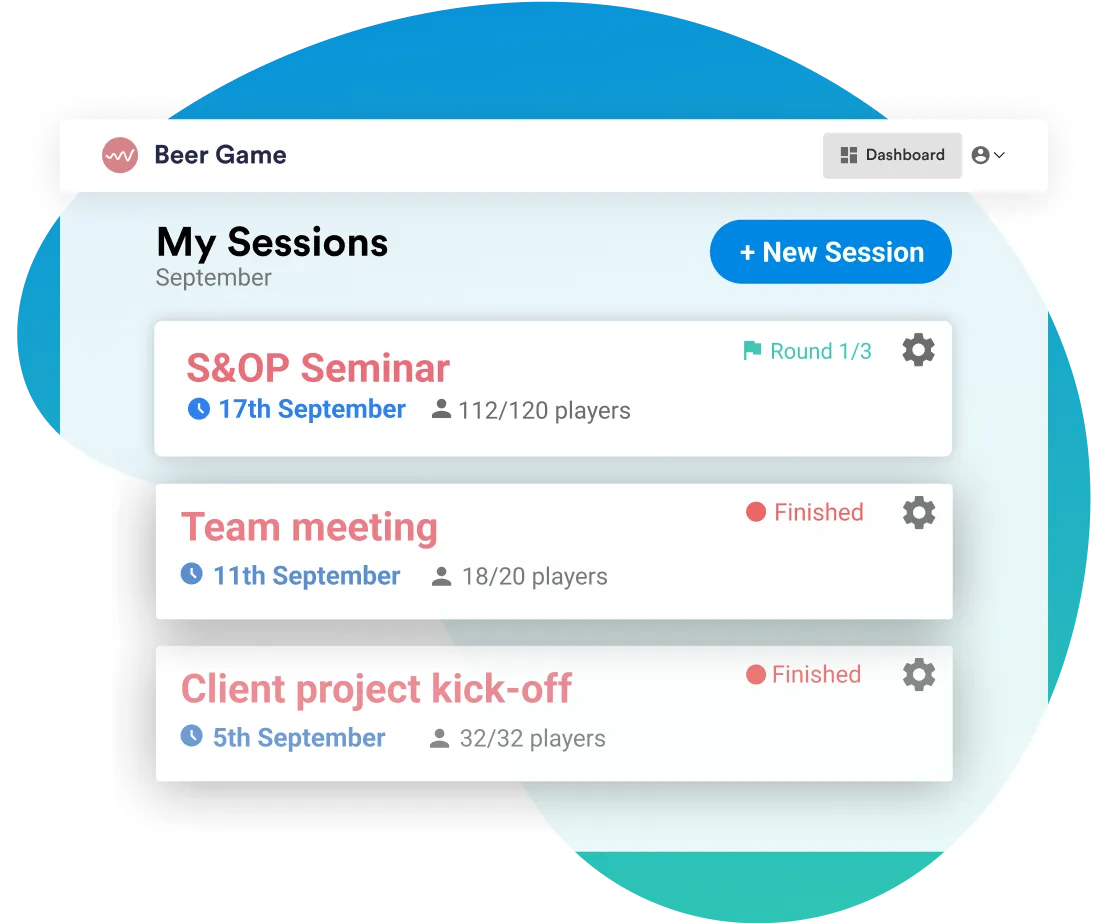
Interface view - Instructor dashboard

FAQ

All you need to know about the Beer Game

How long does a session take?
Plan for 90 minutes to 2 hours end to end. Setting the game up takes a couple of minutes, playing through a run of roughly 20 weeks takes 30 to 45 minutes once players find their rhythm, and the debrief takes the rest — which is where most of the learning happens. You decide how many rounds to run and how long each one lasts, so a session can fit in a lunch break or fill a half-day workshop.
How many players do I need?
Four is enough — one per role: Retailer, Wholesaler, Distributor and Manufacturer. Any seat you leave empty is played by the computer, so you can run with fewer. It scales in both directions from there: put two or three people on each role to spark discussion inside the teams, or run several supply chains in parallel. A single session handles up to 600 participants seamlessly.
Can I play alone?
Yes. The demo puts you in one role with the computer playing the other three, so you can see the whole mechanic in a couple of minutes — free, and no signup. It is the quickest way to know what you are getting into before running a session for a group. Play the demo ↑
Is it free?
Playing solo against the computer is free on every template, with no signup. Multiplayer sessions are paid: the Conference plan covers a one-off event over one month, and the Enterprise/Campus plan is a yearly licence with unlimited instructors, every template and full branding. Pricing is per participant. Universities get a significant discount with an academic email address. See the pricing →
How does this differ from the board version?
The rules are identical: same four roles, same delays, same holding and backorder costs. What changes is everything around them. There is no board, no chips and no order slips to prepare or pack away; stock, orders, backorders and costs are tracked automatically instead of by hand on record sheets; and the charts, rankings and reports are ready the second the game ends. Players can also join from anywhere. A board game rarely goes past a few tables of 4 to 8 players — online, one instructor can run hundreds. Compare both formats →
What is the bullwhip effect?
It's the tendency for demand variation to amplify at every step up a supply chain. End-consumer demand barely moves, yet orders at the factory swing wildly. It happens because each stage sees only its own client's orders rather than real demand, and because deliveries take weeks to arrive — so when stock runs low, ordering extra feels sensible, and the stage above reads that inflated order as genuine demand. The Beer Game reproduces it reliably, which is why it's been the standard way to teach it for sixty years. Read the full guide →
What do players actually learn?
More than how to place an order. Four things tend to surface in every session: how the bullwhip effect emerges from perfectly ordinary decisions, how lead times force you to plan for demand you can't yet see, what optimising your own role costs the chain as a whole, and how much of the difficulty disappears once information is shared. It sticks because players cause the problem themselves rather than reading about it.
How do you win the Beer Game?
By finishing with the lowest cumulative cost — not by having the fullest warehouse. Three habits do most of the work: order steadily instead of reacting to each week's swing, count the cases already on their way before ordering more, and resist over-correcting after a backorder. The counterintuitive part is that playing your own role well isn't enough. The best results come from chains whose decisions make sense together, which is usually what the debrief ends up being about.
Who created the Beer Game?
Jay Forrester and his colleagues at MIT's Sloan School of Management, in the early 1960s. Forrester founded the field of system dynamics and built the game to show why industrial systems oscillate even when everyone in them is behaving reasonably. It spread from MIT to universities worldwide as a board game, and plenty of classrooms still play it that way. See the full history ↑
Do players need supply chain experience?
No — and that's part of why it works. The rules take two minutes to explain and the interface walks each player through their first round. Sessions run just as well with first-year students as with engineers, salespeople or executives who've never thought about inventory. Experience changes the depth of the debrief, not the ability to play.
Do players need to install anything or create an account?
No. Players join from a link in any browser — laptop, tablet or phone — with nothing to install. They pick their role and start. Only the instructor needs an account, to set the session up and follow it live from the dashboard.
What languages is it available in?
The game interface is available in 12 languages, including English, French, German, Spanish, Italian and Portuguese.